How Quickly Can Solar Panels Recharge a Battery?
Solar panels can recharge a battery within part of a day or across a longer solar window, depending on how much usable solar energy reaches storage. The calculation looks simple at first: divide battery capacity by charging power. Real homes add another variable because solar electricity may serve appliances while the battery is charging. Sunlight also changes throughout the day. A more useful estimate therefore follows the battery’s progress from its starting energy level to its target, while accounting for solar production and simultaneous household consumption.
Calculate Recharge Time From Energy Gained
Start With the Empty Space, Not Total Capacity
A battery rarely begins every charging period at the same level. Instead of automatically using its full capacity in the calculation, determine how much energy must be added. For a 5 kWh battery at 40%, the stored amount is mathematically 2 kWh, leaving 3 kWh to reach 100%. If it begins at 70%, only 1.5 kWh separates the current level from full capacity. This “energy gap” is the quantity solar panels need to replace. It also explains why recharge time can differ greatly from one morning to another even when the solar installation remains unchanged. Starting charge becomes the first variable to record when estimating how quickly solar generation can refill a home battery.
Convert Solar Power Into Energy Over Time
Solar panels are rated in watts or kilowatts, but a battery stores energy measured in kilowatt-hours. Time connects the two units. If 2 kW of solar power reached battery charging continuously for one hour in a simplified mathematical example, that interval would represent 2 kWh of energy. At 1 kW for three hours, it would represent 3 kWh. Real solar production varies through the day, so dividing battery capacity by the solar array’s headline rating does not describe an entire charging session. When comparing systems or researching solar power battery price, it is more useful to distinguish between maximum supported solar input and the amount of solar energy that can actually accumulate across the available charging window.
Use Several Solar Intervals Instead of One Daily Average
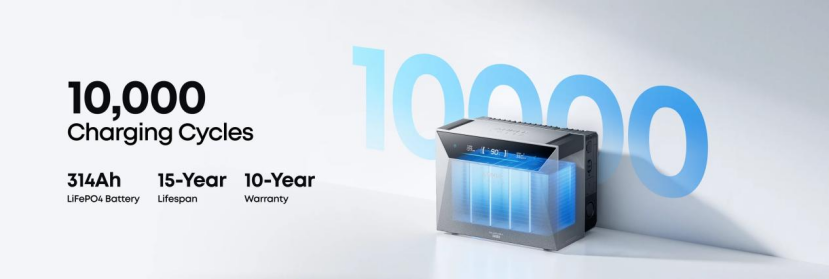
A practical recharge estimate can divide daylight into shorter intervals. For example, record solar energy reaching the system from 9 to 10 a.m., then from 10 to 11 a.m., and continue through the useful generation period. Add those energy amounts until they match the battery’s required energy gap. This method accommodates a changing solar curve without assuming identical production throughout the day. The Anker SOLIX Solarbank 4 E5000 Pro supports up to 5,000 W of solar input. Its four MPPTs support 4 to 12 panels. Rather than interpreting 5 kW as a fixed charging rate throughout daylight, homeowners can use measured production intervals to estimate when the required number of kilowatt-hours has been collected.
Follow Where Solar Energy Goes Before It Reaches Full Charge
Household Consumption Competes for the Same Daylight Hours
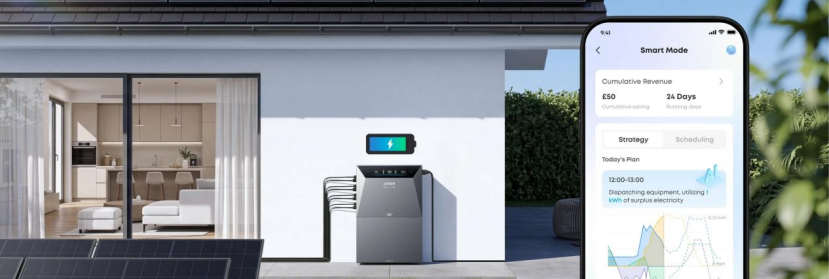
Solar generation and battery charging can happen while the home is consuming electricity. That means total panel production and energy added to the battery are not automatically identical figures. Imagine that a solar system produces 3 kWh during a certain period while household activities use part of the available solar electricity during those same hours. The battery’s charging progress should be evaluated from the energy that actually reaches storage. This creates a useful concept: net charging energy. A quiet weekday morning and an appliance-heavy weekend afternoon can therefore produce different charging progress under similar sunshine. Measuring household consumption alongside solar generation provides a much more household-specific answer to the question of recharge speed.
Four MPPTs Can Manage Multiple Solar Inputs
Panel configuration also belongs in the recharge discussion because solar input must be collected and managed before it becomes stored energy. Solarbank 4 E5000 Pro uses four MPPTs and supports configurations of 4 to 12 panels. MPPT, or maximum power point tracking, manages the operating point of connected solar input so the system can draw available power effectively as solar conditions change. Multiple MPPTs allow separate solar input groups to be managed independently within the system’s supported configuration. For recharge planning, the important point is that panel count alone does not determine how many kilowatt-hours reach the battery during a particular day. Solar availability, system configuration, household use, and the battery’s starting level all contribute to the charging timeline.
Watch the Charging Curve Develop in Real Time
A prediction becomes more useful when it is compared with actual energy data. Solarbank 4 E5000 Pro works with Smart Meter Gen 2 for real-time monitoring. The meter’s dual-circuit design monitors the main grid, while its second channel can track third-party solar output or provide active circuit overload protection. Users can therefore examine changing energy flows as the day progresses rather than relying entirely on a morning estimate. One useful method is to note battery progress at regular times and compare it with solar production and household activity during each interval. After several similar days, these observations can reveal recurring charging patterns and make future recharge estimates more closely aligned with the home’s actual solar and consumption profile.
Conclusion
Solar recharge speed is best understood as an energy-collection process rather than one fixed number of hours. First calculate how many kilowatt-hours the battery needs to gain. Then track how much solar energy becomes available across successive daylight intervals and how household consumption affects the amount reaching storage. Panel configuration and energy management also shape the charging process. Real-time data can then replace broad assumptions with household-specific patterns, making it easier to estimate when stored energy will reach the desired level on different types of solar days.